


Reliable and Safe switching
1. Summary
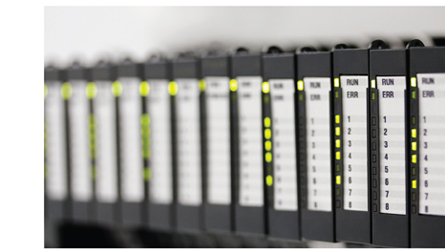
Programmable Logic Controllers (PLCs) are central to modern industrial automation. Relays—particularly slim-line relays— play a critical role in expanding PLC I/O capability, providing electrical isolation, and enabling safe switching of higher-power loads.
This white paper outlines the complete integration process for relays in PLC systems, focusing on relay selection, electrical compatibility, mechanical integration, thermal management, mounting practices, and standards compliance. The goal is to support reliable, compact, and maintainable control panel design.
*In this paper, the term ‘PLC system’ includes the PLC, its I/O modules, and the control panel.
2. Role of Relays in PLC Systems
Relays act as an interface between PLC control logic and field devices. Their primary functions include:
- Electrical isolation between low-power PLC electronics and higher-power field circuits
- Voltage and current adaptation between PLC outputs and external loads
- Protection of PLC outputs from overloads, short circuits, and transient voltages
- Simplified maintenance, allowing inexpensive components to fail instead of PLC I/O modules.
Slim-line relays are particularly well suited to modern panels where space efficiency and modularity are required.
3. Relay Technologies Used with PLC Systems
3.1 Electromechanical Relays
- Physical contacts actuated by an electromagnet
- High isolation and good tolerance to transient overvoltage
- Suitable for inductive and mixed-load applications
- Finite mechanical life
Read the full White Paper here: White Paper Relay Integration in PLC Systems
